Friday, June 21, 2013

Forecast... scattered gardens with a chance of awesome.

In a city as spread out as Albuquerque it is interesting to see the lack of access to local food production. We should all be able to walk or at lease bike to a community garden with ease.  There are plenty of spaces that have been forgotten or abandoned that can be claimed.  It isn't far fetched to suggest that we take a page out of Adam Purple's book and make an unused space an area that can thrive with life, as he did with a rubble filled lot in New York City from 1978-1986.

Adam Purple's Garden of Eden 1976

How great would it be if all of the small parks strewn across this city contained a community garden?  These sites are already set up with watering systems and attract people who live nearby.  It would be a great opportunity for people to get to know their neighbors and learn that they have a common interest. Gardening has been proven to be therapeutic in so many ways.  According to CNN.com gardening provides ,"stress relief, better mental health, exercise, brain health, and nutrition."  Could all of these area be connected by a green boulevard for pedestrians and cyclists?  Of course they could.

Map of envisioned green boulevard and community gardens
With the world moving and evolving at such a rapid pace it only makes sense for us to be forward thinking and realizing that the way that we think about food and it's distribution must also evolve.

Community garden awareness

 With the push to be "green", buy organic, and buy local, more and more people are educating themselves as to what is healthy for their bodies and the planet.  How can we get people to move away from purchasing their produce and local goods at a traditional grocery store and get them out to the local farms where the food is actually being grown and made?  The number one issue is awareness of what's available within a reasonable distance.  What if there were a way to educate not only the people who are actively seeking this information but also the general public.  It is entirely possible to create and distribute maps with just that in mind.

Map of current community gardens in Albuquerque with walking and biking radii and bus routes noted.
 Would it be helpful to people to know that instead of getting in their car and driving 5 minutes to the store to buy their green chile they could walk 1/4 of a mile and accomplish the same thing while also saving gas, supporting a local business, and getting exercise?  I hope so.

Thursday, June 20, 2013

Imagine this...

Remember when you were a kid, and you could transform your backyard, your sheet-draped table, or your tree house into the most fantastical imaginative place you could think of? And once you established this this world, this situation, you could keep sailing on that creative wave, inventing complex scenarios about kings and queens and wizards and elves? Of adventure, struggle, laughter and joy?

Maybe you didn’t steal as many plots and ideas from The Hobbit as I might have, but I’d bet you spun together some very creative adventures, and still continue to tap into that creativity.

In reading about issues of sustainability, I remember seeing a graph of the various “ages” of our human history; we’ve seen the Stone Age, the Iron Age, the Bronze Age, on up through the giant leaps of the Industrial Age. Now we have the esoteric Post Industrial Age. Despite the dedicated attempts of my history professor tor try to drive me to utter boredom, a spark of interest lit up when I thought about that term. The Post Industrial Age. I’ll admit, by itself it’s not particularly interesting or very descriptive. But it implies possibility. Maybe we can’t really describe this age very well because we are in an intersection of possible paths forward. This is what sparked my intrigue, my imagination, the same stuff from where I was a kid.

What happens next? What if we go here and this happens? Adventure, struggle, mystery. What would world will we find, make destroy, regenerate, inherit?

Using our imaginative process to project out a positive path forward into this possibility serves as a key element in tackling the ongoing issues around sustainable development. So often I read the climate change reports, about the dwindling Southwest water supplies, about the blunders of Industrial Agriculture and become overwhelmed in the mountains of bleak data. Or I read the various lengthy plans and strategies with quantified, analyzed, and scrupulous findings that promote sustainable solutions, but become numbed by the dry and dusty communication.

And then I read about projects like Patricia Johanson’s Garden Cities, or Nils Norman’s Edible Park, or wonder for myself what a sustainable future would look like, and I become captive to that creative process; I become engaged, because they offer me an opportunity to directly interact with these fictionally tangible ideas.

Patricia Johanson, Cabbage City, from the Home and Garden Commission, 1969

Patricia Johanson,  Animal Garden:Sheep, from the House and Garden Commission, 1969

Sustainability stems in many ways from a kind of utopian ideal, defining a state of balance and harmony within our human and land communities. But maybe this sustainability stuff isn’t an end goal or a finish line with green flags waving; like Norman’s Edible Park, maybe sustainability lays out a set of ideals and provides a framework for activating the process of sustainability. By allowing us the time to wonder how we could work the process of those ideals better, visioning gives inspiration, creativity, wonder, adventure, laughter, and joy.

Nils Norman with Permacultuur Centrum Den Haag, model for Edible Park, 2010


East Central Ministries Mindfullness

I was extremely impressed with the mindfullness present in all of the operations at East Central Ministries. While getting a tour from Morgan, the manager of Growing Awareness Urban Farm, we got to see the many different components of what this company runs on. I thought it was pretty great how Morgan was so at ease with everything that she explained. To me, having one tomato plant is hard work. When she wheeled out the "extra" plants they were looking to donate, I was amazed. The surplus of plants, of bees, of natural life that exists there seems like a little oasis on Central Ave. It got me thinking about my own life and the people and places I surround myself with. If one man could turn an old hazardous building into a lush and beautiful community center, can't we all modify our lives just a little bit to harness the same harmony? The ollas production was incredible and all done in one place. It got me thinking what kind of micro-business could I start up with my roomates...

Anyway, the whole operation was very inspiring and impressive. Even more so that it has only taken them five years to get to that point. I truly hope to see this idea grow.

Farm Manager Morgan Attema showing the class around the farm.

Beehives and nursery.

Olla production studio.


Fired ollas.


Tuesday, June 18, 2013

Sprouting workshop project with children! (video)

A project i am working on involving children and sprouting! I am attempting to introduce the topic of planting and sprouting to a diverse community within a spiritual setting. Relating the act of sprouting to that of spiritual awakening. The children are intrigued and excited to watch the seeds grow and learn more! Here is a video of their first day planting the seeds! enjoy :)


Sprouting (Part 1) from Moon Drop on Vimeo.

Monday, June 17, 2013

Urban Gardening Survey

Greetings!

I don’t know about you, but I like food. I like local, fresh, and organic food even more. And I’d like to reconnect with this food, start a garden of my own, and connect with others who share these interests. But where to start? How do you know what to grow? Who else is growing food in the city, in the urban foodshed?

This is where I need your input, your ideas, and your creativity to help design an open-sourced urban gardening toolbox to guide, grow, and inspire the city foodshed. This toolbox will take the form of a planter box, with planting guides, adaptive infrastructure, and online connectivity and resource sharing.
 All are welcome to fill out this short survey. (https://www.esurveycreator.com/s/5ba76eb) Feel free to share it with your friends, family, and community.

Thanks so much for your time,


Keenan Boliek-Poling
Urban Garden Toolbox Concept

Monday, June 10, 2013

Food Waste to Compost

An investigation into the local foodshed would not be complete without looking into opportunities for diverting food waste from ending up in the landfill. We began our journey at La Possada, the dinning facility for on-campus residents. We met with Barry Goldberg, Director of Dining Services. He gave us a 'behind-the-scenes' tour of the cooking facilities and gave us an overview of the food-waste collection initiative which has been in place since Chartwells took over Dining Services at UNM 5 years ago.


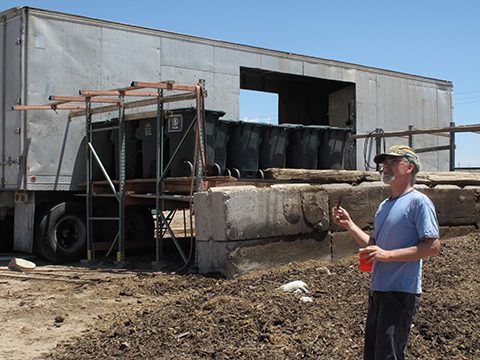
Next, we headed down to Soilutions which is the local company that collects UNM's food waste and transforms it into high quality compost. John Shaski kindly showed us around and helped demystify the composting process.


This platform is where food waste is initially received from UNM and other suppliers .

Students getting a good whiff of the finished, sweet smelling compost.