
UNM Art Studio 389 / 429 / 529. This course provides a context in which students can build on the collective knowledge and experience being developed within the university and local communities and to combine the pragmatic, ecological, and social dimensions of creating urban food gardens with artistic invention and critical, expansive thinking. This blog is a space for posting thoughts, ideas, references, resources, and works.
Friday, June 28, 2013
Nina's class in Local Food, Urban.. I think was a huge success. I have been made aware of the Apartheid wall in Palestine and its effects on the Palestinian's who are "scattered like seeds in the wind". I was moved by her manifesto and hope to see more of her work.I have learned about environmental design from the architecture students and how incredibly meticulous they are about gathering and interpreting information. The photo documentary student showed me how beautifully one can depict the big idea of gardening and how to put that into play. I thought that she had a unique gift of using self reference to figure out her place in the world. The Zine student had a way of coming up with a different view in which she literally showed the different view. Her raw way of drawing I am sure to see in comic for the future. I also enjoyed Nina's generous teaching methods which allowed each student to really perfect their own ideas. I think that this diverse group of students worked well together to bring each person's unique gifts to the table. I did not have the chance to say farewell to everyone, but I hope to see your work in the future. I hope that we all take a bit of the class with us into our lives and think about ways to inform the rest of the world about food, water and conservation. I hope that we all continue to think about food and its place in our lives. If we continue to use up our resources in the same way what will we leave behind for future generations.

"Eat the City"

Great article from the Design Observer on converting abandoned urban spaces into productive, edible landscapes. Click here to view article.
Thursday, June 27, 2013
The Farm by the Freeway project by Bonnie Ora Sherk helped to challenge the concepts of
community art. I like the idea behind
this project to bring about change. I
feel this is another example of how a community can acquire a space in order
educate and inform. “The farm sought to
create a radical ecological model that facilitated nonhierarchical interactions,
a cornerstone of countercultural organization and activism embraced by cultural
radicals from the Diggers to Jerry Rubin’s Yippies. (Crossroad Community(The Farm) by Jana Blankenship,1974-87),
pg.44) This project examined public
urban art. This work explained something
very important which is to exist harmoniously with nature. As the human population grows and slowly
encroaches on all other environments, we must figure out a way to live together
and to provide food for the populace. I agree that unused spaces should be used
for community gardens. Public garden space
should be part of every neighborhood. Along
with the planning of gardens should be a plan to help save water by using
greywater. I feel that this conversation
should be part of the city of Albuquerque’s agenda. Basically, if we don’t have food or water who
will be around to live in the city anyway.
Tuesday, June 25, 2013
Toolbox, Project Update 2.0
Today I poured the papercrete mold for
the first prototype of the toolbox! The process was long and grueling, and
complications with the mixture ratios set me back a bit. After the testing two
of the different mixture ratios, I decided to go with the following recipe, encouraged
by the good results from test mold #2:


- 55% wet paper pulp
- 20% clay (earthenware)
- 15% Portland cement
- 10% dry sand

Test mold #2

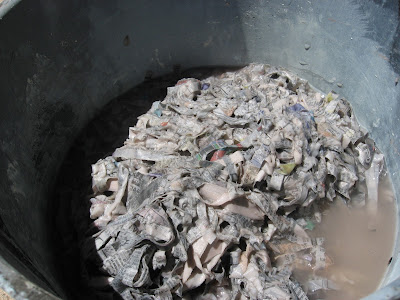
Paper shredding and pulping—the first step—turned out to take up
the most time. I used my paper shredder to munch up about three days of Albuquerque Journal newspapers, and then put this chaotic jumble into a five
gallon bucket and filled it with enough water to cover the paper to blend it with
a mixing bit.


With the paper, I learned that a
longer soaking time kept the paper from just spinning around and clumping up around
the drill bit, and this is where most of the delays came from. Blending with
the mixer drill bit resulted in this very soggy paper pulp, which needed
staining off of its excess water.
At the same time the paper soaked
away, I got my very dried out clay soaking as well. (If you were using new
earthenware clay, soaking wouldn’t be needed.)
Next up, measuring and mixing! Because
of the volume the mold needed, I ended up using two five gallon buckets. The
actual volume of the mold was a little less than 1 cubic foot. After some
number crunching, I marked off the percentages on the side of the buckets. Then
I added all the ingredients, layering them for easy measuring.
What followed was a frenzied shoveling/mixing/drilling
rampage. I was so covered in clay and cement I dared not touch the camera, but here
is the completed pour after I filled the mold. I had some warping issues with
the side panels, which is why it bears a resemblance to a fortress with all the
blocks.


Not too shabby! My biggest concern
is the drying time, but I feel confident that it will be able to survive the
drive to campus on Thursday. The Portland cement will be cured by then (it's already setting up nicely), and the
rest of the moisture will soon follow.
Exciting stuff!
Front lawn = world of opportunity
After World War II, when the soldiers came home and the economy stabilized and then boomed an interesting thing happened, the American dream was revamped to include a single family home with a pristine front lawn. This lawn was used as a buffer from the street, a subject of pride in the lush grass, and a sign of wealth based on the size. Although this trend started over 50 years ago it is still as strong today.

In areas of the southwest where water is scarce the public has become aware of xeriscaping. They pull up their grass and irrigation systems to fill in the space with water wise plants and lots and lots of gravel. This does solve the issue of having water guzzling grass from curb to threshold but it doesn't give a usable space.

Edible Estates is a concept started by Fritz Haeg in 2006. He has proposed that the front yard be used as a productive garden using site specific plants. The first project was installed in Salina, Kansas and was an innovative move. Since then Haeg has been embraced by people in the Art, Landscape Architecture, Sustainability fields as well as Foodies and environmentalists. It started out as an unknown project but now 16 yards and many countries later, Fritz is being bombarded with people offering up their yards to him. The volunteers needed for these projects flood in are distributed over many days of installation.

Not only are the people who live in these homes benefiting from the lower water bill and year round fresh produce, but also a sense of community. These front yard gardens are a talking stick that bring people together and give them the opportunity to educate and inform about the project and it's benefits.
Edible Estates has started a conversation and transformation. People are taking this concept and running with it. Even without Haeg's help or designs, homeowners are tearing up the grass and making a front yard that truly gives back to the resident and the community.


In areas of the southwest where water is scarce the public has become aware of xeriscaping. They pull up their grass and irrigation systems to fill in the space with water wise plants and lots and lots of gravel. This does solve the issue of having water guzzling grass from curb to threshold but it doesn't give a usable space.

Edible Estates is a concept started by Fritz Haeg in 2006. He has proposed that the front yard be used as a productive garden using site specific plants. The first project was installed in Salina, Kansas and was an innovative move. Since then Haeg has been embraced by people in the Art, Landscape Architecture, Sustainability fields as well as Foodies and environmentalists. It started out as an unknown project but now 16 yards and many countries later, Fritz is being bombarded with people offering up their yards to him. The volunteers needed for these projects flood in are distributed over many days of installation.

Not only are the people who live in these homes benefiting from the lower water bill and year round fresh produce, but also a sense of community. These front yard gardens are a talking stick that bring people together and give them the opportunity to educate and inform about the project and it's benefits.
Edible Estates has started a conversation and transformation. People are taking this concept and running with it. Even without Haeg's help or designs, homeowners are tearing up the grass and making a front yard that truly gives back to the resident and the community.

Friday, June 21, 2013
Toolbox, Project Update 1.0
This is really just a brief snapshot of today's events :) Yesterday I poured two test molds of the "papercrete" mix, each using different recipes.
Mold #1 uses 65% wet paper pulp, 20% damp earth (with high clay content), and 10% Portland cement.
Mold #2 uses about 55% wet paper pulp, 20% damp earth (with a higher sand content), 15% Portland cement, and 10% dry sand.
Mold #1 has been drying for over 30 hours and is still not entirely dried. Hear's hoping it'll hurry up! Next time I think I'll drain the paper pulp a bit more try and to speed things up. I'll post some pictures of both of them soon, when they have cured a bit longer.
Today, I've been modeling, measuring, procuring, and cutting various plywoods and blocks for a scaled Toolbox mold.
It's been a tedious process, but worth the time to get the right shape. Next up will be assembling the outer and inner molds, mixing up a large batch up papercrete, and pouring! Can't wait to upload some pics!
Cheers all :)
Mold #1 uses 65% wet paper pulp, 20% damp earth (with high clay content), and 10% Portland cement.
Mold #2 uses about 55% wet paper pulp, 20% damp earth (with a higher sand content), 15% Portland cement, and 10% dry sand.
Mold #1 has been drying for over 30 hours and is still not entirely dried. Hear's hoping it'll hurry up! Next time I think I'll drain the paper pulp a bit more try and to speed things up. I'll post some pictures of both of them soon, when they have cured a bit longer.
Today, I've been modeling, measuring, procuring, and cutting various plywoods and blocks for a scaled Toolbox mold.
 |
| Hooray for SketchUp! |
It's been a tedious process, but worth the time to get the right shape. Next up will be assembling the outer and inner molds, mixing up a large batch up papercrete, and pouring! Can't wait to upload some pics!
Cheers all :)
The Urban Food Revolution seems to be a somewhat isolated
occurrence. The same people visit
community gardens and participate in farmers markets. I would love to reach a more diverse
audience. The way that we feed cities
must be taken into account in Albuquerque.
I see a growing change such as the East Central Ministries. People in a city could elicit change by
refusing to eat “empty” food. The
reality is that empty food is cheap and fast.
Why can’t real food be more affordable? Through community involvement we could
teach families how to make whole foods from scratch and to grow food in their
own gardens. I hope that guerilla gardening can take more root. There is endless open ground in Albuquerque
that could be used for community gardening.
Maybe people in Albuquerque should take it upon themselves to plant in
these areas. The city of Albuquerque
should try to fund a nonexpensive way to gather food and resources within city
limits. I like the idea of small mobile units that move around Albuquerque bringing education and functional resources to an area. Nils Norman created a mobile library/greenhouse and the Geocruiser. The Geocruiser was equipped with solar array, and a worm composter. It reminds me of the mobile libraries which would go into neighborhoods giving out books where access to books was limited.
 |
| Nils Norman, Geocruiser, 2001 |
 |
| Nils Norman, The Gerard Winstanley Radical Gardening Space Reclamation Mobile Field Center and Weather Station Prototype (NYC Chapter), 1999 |
Subscribe to:
Posts
(
Atom
)